
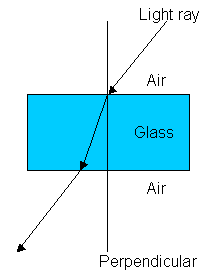
Refraction of light is the bending of light rays at the interface of dissimilar substances. When light is passing from a lower refractive substance into a higher refractive substance the light rays bend toward the perpendicular to the surface. When light is passing from a higher refractive substance into a lower refractive substance the light rays bend away from the perpendicular to the surface.
|
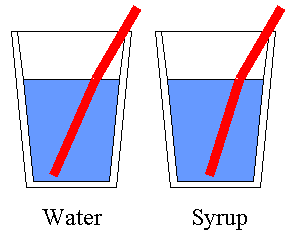
Refraction can be easily demonstrated by placing a spoon, fork, knife, or straw in a glass of water. As the light passes from the air into the water it is bent and the utensil appears bent. To see the increased refraction with an increase in solution density, note the greater apparent bend of the utensil in corn syrup. It should be noted that in these examples the light actually passes from air through glass through water through glass again then exits to air. The reverse passages through the glass cancel each other out and the apparent bend in the utensil is overwelmingly due to the difference in refractive index of air and water.
|
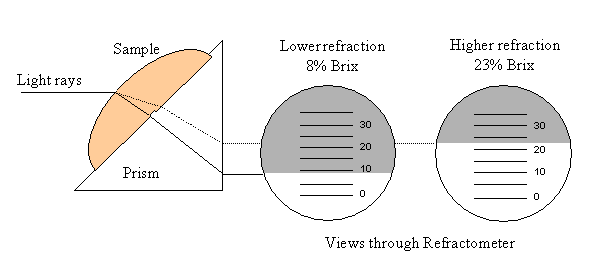
Refractometers are instruments that measure the bending of light as it crosses an interface between dissimilar substances and converts the bending light rays into a useful scale. Refractometers are commonly used to measure salinity of sea and aquarium water, the solids content of urnine, the water content of industrial fluids like brake and hydraulic fluids, the sugar content of fruit and fruit juices, and, of course, the sugar content of wort and finished beer.
It must be remembered that refractometers measure the refraction of light relative to some standard and some substance. For instance a refractometer calibrated to measure the salinity of water can be used to measure a sugar solution, but such a measurement is not accurate for sugar. Likewise, using a refractometer meant for fruit juices is not truely accurate for wort and beer. It is accurate "enough" for wort, since wort is largely simple sugars and their refractive behavior is close to that or sucrose. However, without some "interpretation" it is not accurate for finished beer due to the alcohol content.
The most useful refractometers for brewing use are calibrated in % Brix. This measure is the weight of sucrose in 100 grams of solution. Since 1 milliliter of water weighs 1 gram, in this context grams of water and milliliters (mls) of water are interchangable. Dissolve 10 grams of sucrose in 90 ml of water. This is a 10% sucrose solution which is to say a 10% Brix solution.

Last modified: Wed 17 Feb 2003