
I have 2 ways of connecting the false bottom to the outside world. The first is all metal, using copper tubing and flare fittings (Parts list II). The second uses hose barbs and plastic tubing (Parts list III). If you decide to go with the plastic tubing method make sure that the tubing you buy is rigid enough so as not to collapse under the weight of the grain bed.
Remove the push button spigot from the cooler. Make sure that you do not damage the washer.
Wrap a few layers of teflon tape on the threads of the hose barb and screw it into the bulkhead fitting. You may need to slightly round the corners of the hose barb fitting to get the bulkhead nut over it.
Wrap a few layers of teflon tape on the threads of the flare butt fitting and screw it in the other end of the bulkhead fitting.
Drill a center hole in the pizza pan to accept the 90 degree flare elbow and screw it into the hole and secure with nut on underside.
With a sharp knife slit the tubing down its length on one side.
Fit the slit tubing around the circumference of the pizza pan.
Insert the bulkhead fitting through the hole in the side of the Gott where the spigot was removed.
Finger fit the flare connector in the center of the pan to the flare connector on the bulkhead fitting.
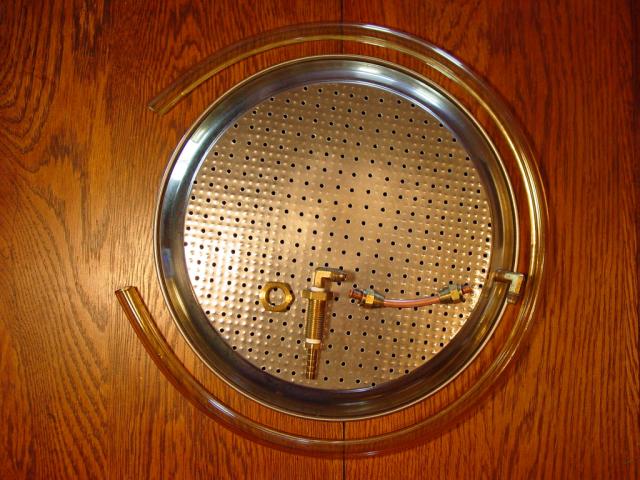 Here are the parts. The bulkhead fitting and the hose barb and the elbow
have been assembled. Note that in this example the pickup on the pie plate
is on the side. I'd suggest putting it in the middle instead. In such case
no elbow would be needed on the bulkhead fitting, but a straight connector
instead.
Here are the parts. The bulkhead fitting and the hose barb and the elbow
have been assembled. Note that in this example the pickup on the pie plate
is on the side. I'd suggest putting it in the middle instead. In such case
no elbow would be needed on the bulkhead fitting, but a straight connector
instead.
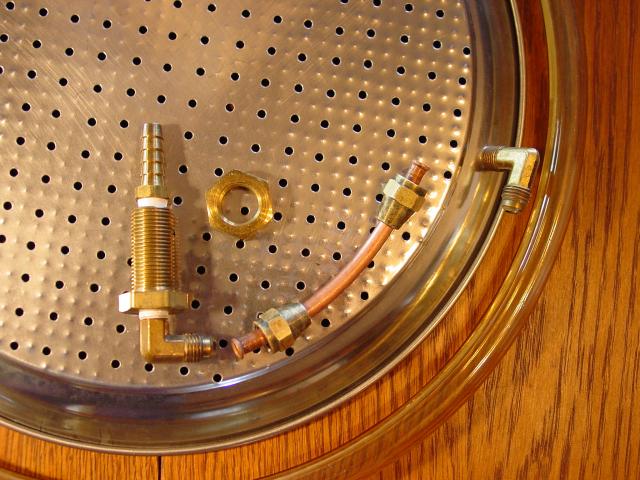 Close up of the hardware. Note that the copper tube has been flared. Put
the caps on the tube BEFORE flaring.
Close up of the hardware. Note that the copper tube has been flared. Put
the caps on the tube BEFORE flaring.
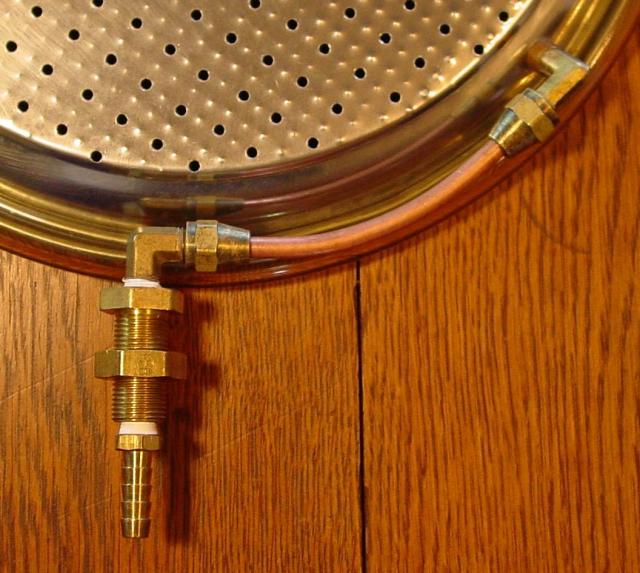 Here is the hardware assembled. The wall of the Gott cooler would be
between the nuts on the bulkhead fitting. The outside nut can be snugged
finger tight. Note that the vinyl tubing has been pressed around the
circumference of the pie pan.
Here is the hardware assembled. The wall of the Gott cooler would be
between the nuts on the bulkhead fitting. The outside nut can be snugged
finger tight. Note that the vinyl tubing has been pressed around the
circumference of the pie pan.